In the minds of many forklift users, counterweights seem to be "the heavier, the more stable." However, this intuitive assumption significantly deviates from the scientific principles of engineering design. A heavier counterweight is not always better; excessive weight can actually lead to a series of significant and unavoidable problems — a consideration that applies equally to every electric forklift, internal combustion forklift, or any model from brands such as CHINLIFT Forklift.
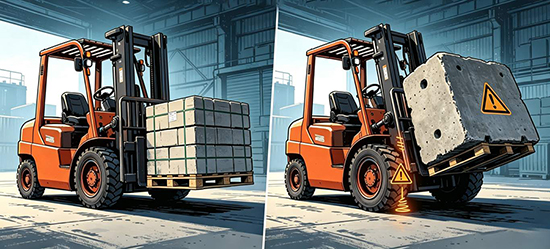
The Basic Function of Counterweights
The core function of a forklift counterweight is to balance the load on the forks and prevent the vehicle from tipping forward. According to the principle of leverage, the counterweight must provide sufficient torque to counteract the load torque. However, "sufficient" does not mean "the more, the better."
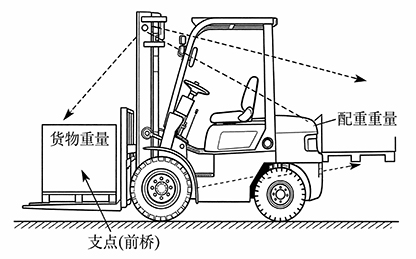
Five Major Drawbacks of Excessive Counterweighting
1. Reduces effective load capacity
Counterweights are part of the forklift's own weight. Adding excessive counterweight significantly increases the total vehicle weight. Under the premise of a fixed maximum rated total weight, this actually reduces the weight available for the actual cargo — a counterproductive trade-off. Whether you operate an electric forklift or an internal combustion forklift, this principle remains unchanged.
2. Accelerates wear on critical components
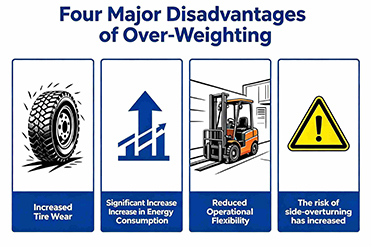
Every additional unit of weight increases the load on the drive axle, tires, steering system, and braking system. Accelerated tire wear, longer braking distances, and premature fatigue in the drivetrain — these maintenance costs often add up unexpectedly later on. Even a robust CHINLIFT Forklift is not immune to the accelerated wear caused by excessive counterweighting.
3. Significantly increases energy consumption
Whether it's an internal combustion forklift or an electric forklift, a heavier body means higher energy consumption. Fuel consumption rises, battery range decreases — the long-term operating costs are considerable. For an electric forklift, excessive counterweight directly shortens shift life between charges; for an internal combustion forklift, it leads to noticeably higher fuel bills.
4. Reduces maneuverability and flexibility
Excessive counterweight reduces the forklift's agility, making operation more difficult in confined spaces such as narrow warehouses, loading docks, and truck tail lifts. Meanwhile, increased ground pressure may damage warehouse floors or loading ramps. A properly designed CHINLIFT Forklift balances counterweight precisely to preserve maneuverability without sacrificing stability.
5. Increases safety hazards
Excessive counterweight alters the forklift's center of gravity. During sharp turns or operations on slopes, lateral stability may actually worsen, increasing the risk of tip-overs. Additionally, greater inertia during emergency braking makes handling more difficult.
Conclusion
Excellent forklift design focuses on "precise counterweighting" rather than "blindly adding weight." Manufacturers such as CHINLIFT Forklift scientifically calculate the optimal counterweight based on parameters such as load curves, mast height, and tire specifications — customizing the balance for each electric forklift and internal combustion forklift model. In actual operation, users should strictly adhere to the rated lifting capacity and never add counterweights on their own to compensate for overloading. Balancing safety and efficiency is the correct approach to forklift operation.