How different are the motor controllers of electric two-wheelers designed by different manufacturers?
The answer is not found in the parameter tables, but lies in each rider's riding experience.

I. The True Manifestation of Differences
As the electric two-wheeler market continues to grow globally, the motor controller has become one of the key components that significantly affect the overall performance, efficiency, reliability, and driving experience of the vehicle.
Many users will find that even if two motor controllers are marked with the same voltage, current and power parameters, their actual performance when installed in a vehicle can be completely different. Some controllers offer smooth starting, strong acceleration, low temperature rise, and can operate stably for a long time; while others, although their parameters seem the same, may encounter problems such as insufficient power, sluggish response, severe motor overheating, low efficiency, and even high failure rates.
II. Why the actual performance differs under the same parameters
Parameters are merely the basic specifications of the hardware, but the actual performance of the controller is determined by the design of the entire system.
The definition of current output capability varies. For example, when labeled with a peak current of 100A, some manufacturers specify it as "continuous stable output", while others specify it as "instantaneous peak". Additionally, due to differences in heat dissipation design and temperature protection strategies, some controllers can output a large current for a long time, while others can only maintain this high current for a few seconds before reducing power.
The levels of control algorithms vary. The controller determines how much power the motor should output through software algorithms. Algorithms that are excellent result in smooth starting, quick response, and high efficiency; while algorithms that are rough lead to jerky starting, low-speed jitter, high-speed power loss, and high energy consumption. With the same hardware configuration, different software adjustments can result in a difference of several levels in the actual riding experience.
Therefore, a truly outstanding controller is a combination of hardware capabilities and software algorithms. Below, we will specifically analyze the design differences among different manufacturers from three dimensions: algorithms, power devices, and heat dissipation reliability.
To determine whether a motor controller is excellent, one cannot merely rely on the product parameter table. Instead, a comprehensive assessment of the following aspects is required:
III. Control Algorithm: Determining the Driving Experience of Electric Vehicles
In the design of the motor controller, the control algorithm is a crucial factor influencing the driving experience of the vehicle.
In the early days, electric two-wheelers mostly adopted the traditional BLDC control method. This approach was mature in technology and had low costs, which could meet the driving needs of basic electric vehicles. However, as the market's demands for high-speed performance and driving experience increased, the traditional control method gradually revealed some limitations:
- Insufficient smoothness at low speeds;
- Obvious noise from the motor;
- There is still room for improvement in energy conversion efficiency.
Therefore, an increasing number of mid-to-high-end electric vehicles are adopting FOC (Field-Oriented Control) technology. FOC achieves more efficient and smoother power output by precisely controlling the motor's magnetic field. Compared to traditional control methods, FOC controllers typically have:
- Better low-speed torque performance;
- Faster power response;
- Lower operating noise;
- Higher energy efficiency.
For applications involving 60-80 cm two-wheelers and three-wheelers, since these vehicles need to balance both starting power and high-speed stability, the controller not only needs to output sufficient current, but also requires excellent software tuning capabilities.
In actual development, a controller suitable for the 48V-96V pure electric platform usually requires parameter optimization based on different motor types, vehicle weight, and usage environment, including:
| Parameter | Effect |
| Peak Phase Current Control | Determines acceleration performance and peak power output |
| Field Weakening Control | Affects high-speed operation capability |
| Torque Response Curve | Influences ride smoothness and drivability |
| Regenerative Braking / Energy Recovery Strategy | Impacts range performance |
With the same hardware specifications, the software tuning capabilities of different manufacturers often result in significant performance differences.
IV. Power Device Design: Determines the Output Capacity and Reliability of the Controller
Apart from the software algorithms, the hardware design also determines the performance of the controller.
The core components include:
- MOSFET power module;
- drive circuit;
- current sampling module;
- main control chip;
- filtering and protection components.
Proper manufacturing companies will adopt more reasonable power module designs and select different current level schemes according to application requirements:
| Application Scenario | Typical Requirements | Controller Design Focus |
| Two-Wheeler | High-speed power delivery, fast dynamic response | Peak current capability, precision control |
| Three-Wheeler | Heavy load capacity, continuous operation | High reliability, sustained output capability |
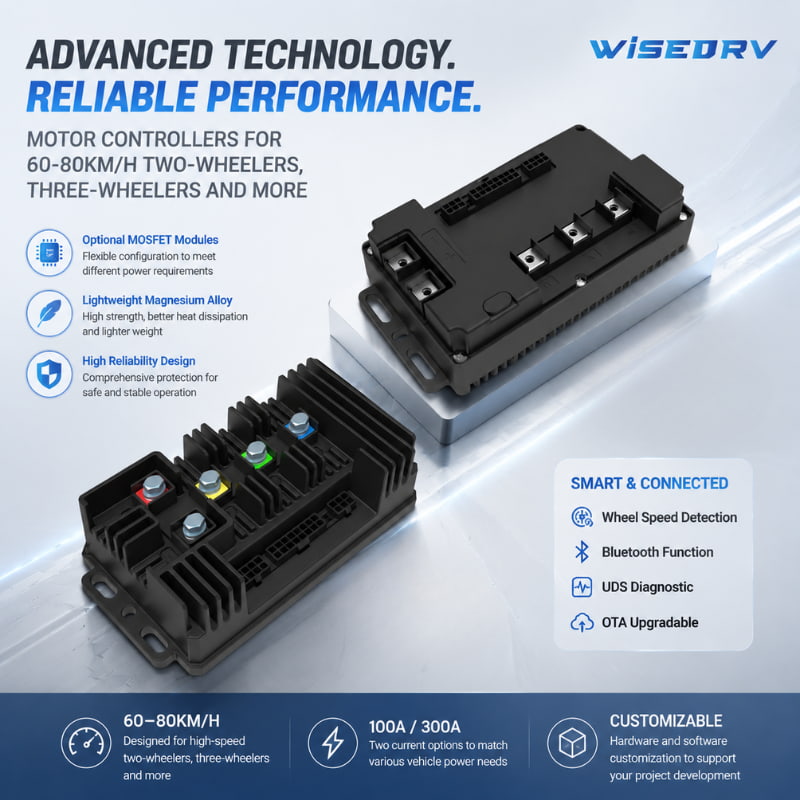
For the application of 60-80 km/h electric two-wheelers and three-wheelers, the 48V-96V pure electric controller platform developed by WISEDRIVEPOWER supports the configuration selection of MOSFET modules, and can be matched according to the power requirements of different vehicle models.
This platform supports CAN communication and can handle a wide voltage range from 48V to 96V. It offers a 300A high current brushless motor controller 48v with a peak current output capability of level. As a 48V-96V CAN-enabled custom motor controller, it can be flexibly customized at both the hardware and software levels according to customer requirements, and is suitable for various applications in light electric vehicles.
V. Heat Dissipation and Reliability Design: Determining the Long-Term Performance of the Controller
During the operation of the motor controller, a significant amount of heat is generated, especially when a large current is being output.
If the heat dissipation design is inadequate, even if the performance meets the requirements for a short period of time, after long-term operation, the following issues may occur:
1.Decrease in power
2.Temperature protection
3.Shortened lifespan of components
4.Reduced system stability
Therefore, excellent controllers usually optimize heat dissipation from both the structural and material aspects. For example:
- Use a high-conductivity aluminum alloy casing;
- Optimize the layout of internal power components;
- Enhance the natural cooling effect;
- Design the heat dissipation path according to the vehicle installation position.
For electric vehicle applications, lightweighting and heat dissipation capabilities are equally important.
The 48V-96V electric vehicle control platform of WISEDRIVEPOWER adopts a lightweight magnesium alloy motor controller design. This design not only reduces the overall vehicle weight but also takes into account structural strength and heat dissipation requirements, making it more suitable for vehicles with specific weight and performance requirements.
VI. How to Select an Appropriate Motor Controller Supplier
For electric vehicle manufacturers, choosing a motor controller supplier is not simply a matter of comparing prices or parameter tables. Instead, it should involve a comprehensive assessment of the supplier's R&D capabilities, product reliability, customization ability, and long-term cooperation capacity.
A truly outstanding motor controller supplier can provide customers with support throughout the entire process from product design, performance optimization to mass production, offering stable, efficient and reliable electric drive solutions for the entire vehicle enterprise.
VII. Frequently Asked Questions (FAQ)
Q1: What are the fundamental differences between motor controllers designed by different manufacturers?
The core differences lie in the precision of the control algorithm, the selection of power components, and the heat dissipation design. The parameter table only indicates the upper limit; the actual riding performance is what matters most.
Q2: How can one quickly determine the reliability and production consistency of controllers from different manufacturers?
The reliability differences mainly stem from component quality, heat dissipation structure, and environmental testing standards. Quality manufacturers will conduct factory tests such as high-temperature aging, vibration, and waterproofing, and strictly control production consistency. It is recommended to visit the factory in person, request third-party inspection reports, and verify the actual performance by testing the sample vehicles.
WISEDRIVEPOWER focuses on the research and development as well as manufacturing of motor controllers. As a Built-in VCU UDS OTA Motor Controller Factory, we are dedicated to providing stable, efficient and reliable electric drive solutions for vehicle manufacturers. If you want to learn more about the product information, please click on the detail page; or if you need a customized solution, you can click on "Contact Us" on the homepage for consultation.